- Status
- Live
- Year
- 2026
- Role
- Design, model training and full development
- Stack
- Nuxt
- TypeScript
- ONNX Runtime Web
- WebGPU
- YOLO
- Python
- PWA
- WebSocket
Private source code: the architecture and the results are shown here.
The context
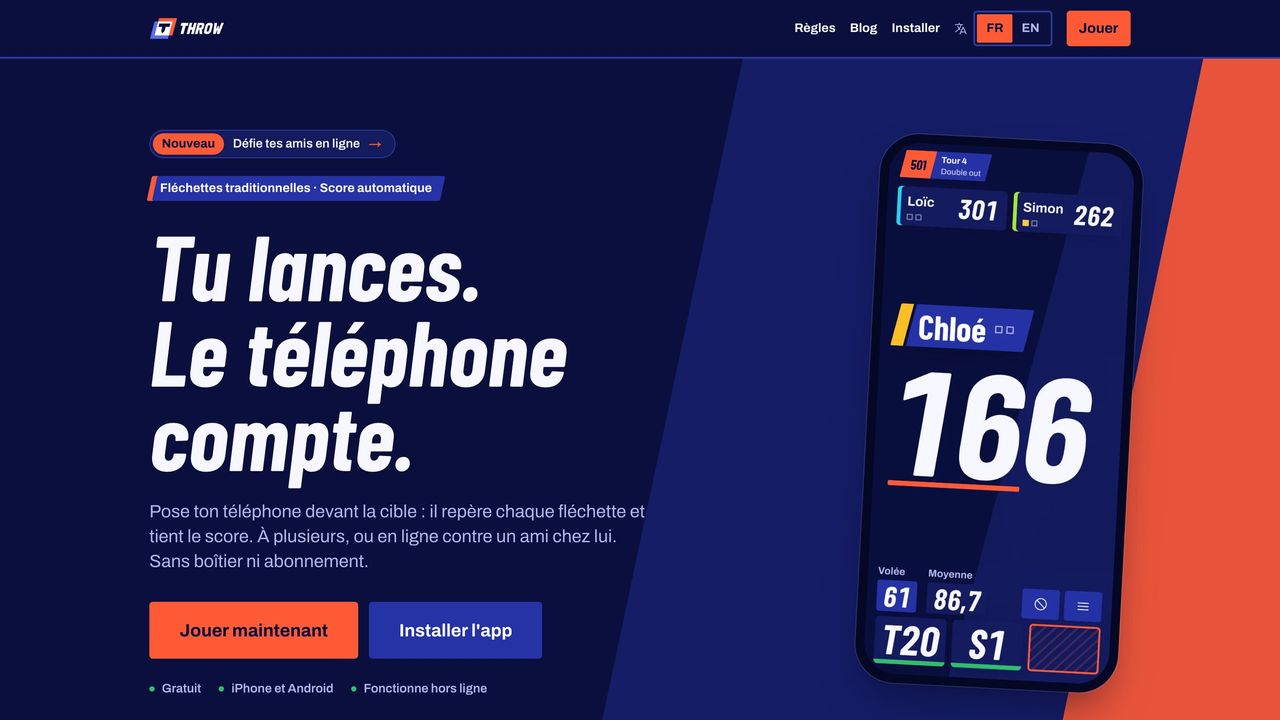
Automatic darts scoring systems need several cameras mounted around the board and a dedicated computer. I wanted a phone set in front of the board, with no server and no extra hardware.
What I built
A Nuxt PWA that detects the board and the dart tips in real time with ONNX Runtime Web (WebGPU, WASM fallback). I trained and benchmarked seven generations of my own YOLO pose models on audited datasets and hand-labelled throws, then kept the best pipeline: the difference between two frames first, the model next.
Architecture
- 01CaptureThe phone camera films the board, frames stabilized.
- 02CalibrationThe board corners are detected to straighten the view.
- 03DifferenceBefore and after the throw are compared to isolate the dart.
- 04TipThe pose model locates the tip to the millimetre.
- 05ScoreThe point is mapped on the board and the game is updated.
Results & impact
- 71 to 96 ms per inference with WebGPU on iPhone, 175 ms with WASM, fully on the device.
- 88% of darts right against Autodarts with the difference pipeline, versus 57% from the photo alone.
- Median error of the board corners down from 7.1 to 2.7 mm across trainings, about 400 tests.
Skills applied
- Computer vision
- Model training
- Full stack product
Got a project in mind?
An application to build, a team to strengthen or an AI product to launch: let's talk.